Vanity Metrics: Neat, Plausible, and Wrong
H. L. Mencken wrote in 1920: "There is always a well-known solution to every human problem— neat, plausible, and wrong."
I was reminded of this quote when I came across a name for an anti-pattern that I have found in my professional life: vanity metrics. Vanity metrics are measurements that appear impressive on the surface but often fail to reflect genuine business performance, sustainable growth, or actionable insights.
Several years ago, a senior executive asked me to start measuring my team's performance by showing how many story points each team completed by sprint. This metric is easy to track, but it does not represent any useful information. Story points are arbitrary, used by teams as a quick way to estimate how many issues they can include in a sprint. Each team will have its own view of story points, making team to team comparisons worthless. Moreover, if a team knows that story points are used to measure performance, they will assign increasingly large values over time to show improvement. Fortunately, with the support of the project management leadership, I was able to push back on this request.
In 1982 Apple was working on the Lisa, the predecessor of the Mac. Management decided to track contributions of the individual engineers by asking them to record the number of lines of code submitted. This is a poor measure, as it encourages writing verbose code and not focusing on clarity. The absurd nature of the request became clear when one engineer, Bill Atkinson, was optimizing the library responsible for UI design. During one week, he sped the library up six-fold and removed 2000 lines of code. So when asked for lines of code, he submitted negative 2000. That was the beginning of the end of this vanity metric for the Lisa team.
Away from software engineering, studies show the downside of using Average Handle Time in a customer service environment. One company required agents to keep their calls to 480 seconds. This resulted in agents ending calls as they approached the allotted time, even if the customer’s issue was unresolved. This required multiple calls, which took more total time, and decreased customer satisfaction.
The latest vanity metric that seems to be gaining traction is to measure productivity by how many AI tokens an employee uses. This actively encourages wasteful use rather than a considered approach that focuses on delivered benefit.
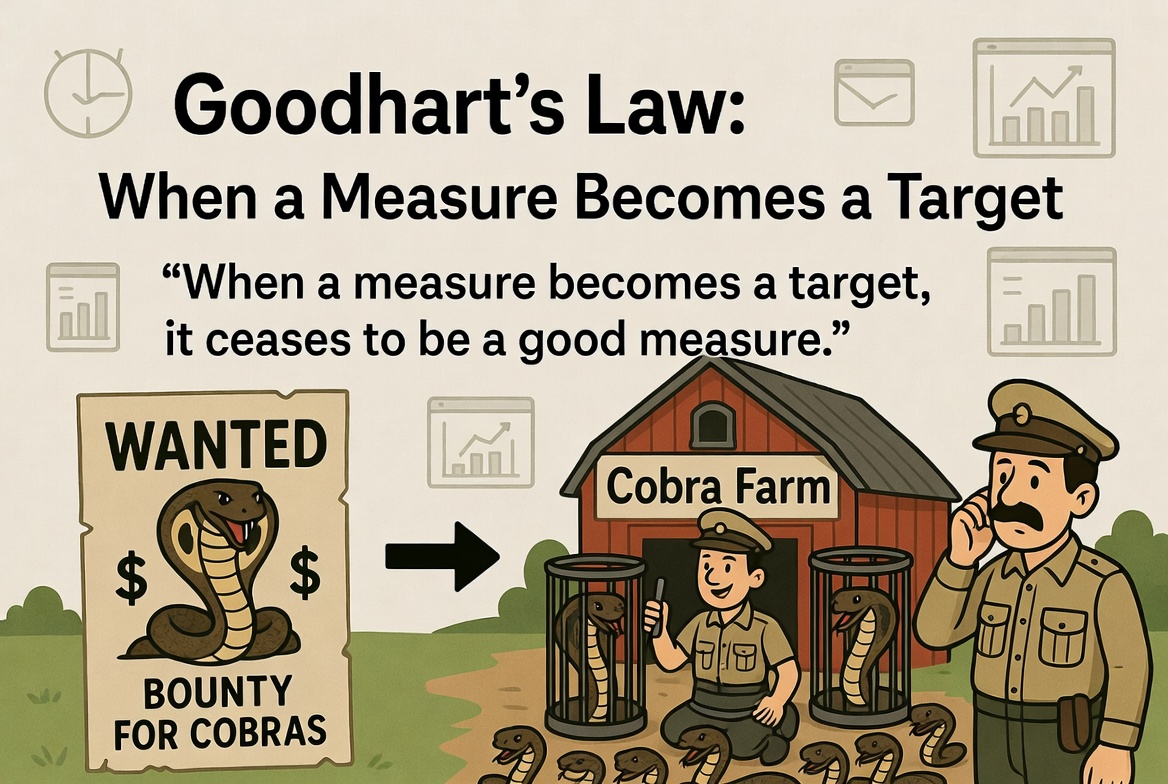
This ties into Goodhart’s Law: "Any observed statistical regularity will tend to collapse once pressure is placed upon it for control purposes." This is often paraphrased as: "When a measure becomes a target, it ceases to be a good measure." Measurements as targets cause people to change their behavior to focus on the measurement rather than the real desired result for which this measure is a proxy.
Measuring the output of knowledge workers is hard. That is not an excuse for management to find an easy to record metric and use that. As the examples above show, this approach not only fails to measure real output, it may actively encourage behavior that is the opposite of the desired outcome.